




Most paid advertising campaigns don’t fail because of the platform. They fail because of poor setup, weak tracking, and misaligned strategy. Businesses pour money into Google Ads and Meta Ads expecting fast results, only to watch clicks arrive without any meaningful conversions. The problem is almost always structural, and fixing it is more straightforward than most people think.
According to Google Ads Benchmark Report, average conversion rates across industries vary significantly, from under 2% in the lowest-performing sectors to over 13% in the highest, with an overall cross-industry average of 7.04%. That means the majority of your clicks may never convert, even in well-managed campaigns.
This article identifies exactly where paid advertising budgets leak and gives you practical fixes to stop it. If you are also building your organic presence alongside paid campaigns, it helps to have a solid SEO strategy running in parallel.
Why Most Paid Ad Campaigns Fail Before the First Click
A surprising share of campaign failure happens before a single ad goes live. The most common cause is a mismatch between business goals and campaign configuration. Running traffic-focused campaigns when your actual goal is sales, for example, inflates click volume while delivering little return.
Two other pre-launch problems compound the issue:
Weak audience definition: Broad targeting increases reach but kills relevance. Paid advertising platforms depend on clear signals. Without them, the algorithm cannot find the right users and it will not.
Landing page misalignment: If your ad promises one thing and your landing page delivers another, users bounce immediately. That is wasted spend even when the ad itself performs well. A slow or cluttered landing page makes this worse. Website speed directly affects how many visitors stay long enough to convert.
Solving these issues before launch prevents the most expensive mistakes in PPC campaign optimization.
The Four Hidden Budget Drains in Paid Advertising
Budget waste in paid advertising typically comes from four sources that are not always obvious from the dashboard.
1. Targeting Inefficiency
Ads shown to the wrong audience almost never convert. This includes overly broad demographics, low-intent keywords in Google Ads, and poorly defined audience segments in Meta Ads. Without tight targeting, your ad spend is essentially a donation. Google’s own documentation on keyword match types shows how much control advertisers actually have over who sees their ads, yet most campaigns never use it properly.
2. Messaging Mismatch
Ad creative that does not match user intent generates low-quality clicks. Showing a heavy discount offer to someone still in the research phase, for instance, often results in clicks with no purchase intent. Every message must align with where the user is in the buying journey.
3. Platform Misuse
Google Ads and Meta Ads are fundamentally different tools. Google captures existing demand, meaning people actively searching for what you offer. Meta creates demand, meaning it interrupts users to introduce something they were not looking for. Using the same strategy on both platforms is one of the most common and costly mistakes in paid advertising. Meta’s Ads Manager guide outlines how their system optimizes delivery, and understanding it helps avoid basic structural errors.
4. Tracking Gaps
Without accurate conversion tracking, you are flying blind. Missing events, broken pixels, and duplicated setups lead to scaling campaigns that lose money while pausing the ones that actually work.
When Traffic Looks Good but Revenue Stays Flat
High traffic metrics including impressions, clicks, and strong CTR can mask serious performance problems. The underlying issue is usually intent. Not every click carries equal value. A user searching “best project management software” is in a different buying stage than someone searching “buy project management software now.”
Focusing only on top-of-funnel metrics hides this gap. Performance marketing works best when campaigns are built around the full funnel, not just traffic generation. If your traffic numbers are strong but revenue is flat, audit the intent alignment of your keywords and creatives before increasing your budget. Businesses running digital marketing strategies across multiple channels often catch this gap faster because they can compare intent signals across platforms.
Platform-Specific Mistakes That Compound Over Time
Google Ads
Using broad match keywords without layered controls pulls in irrelevant traffic at full cost. Ignoring search intent and relying on generic terms attracts low-quality clicks. Routing all traffic to a single landing page regardless of the ad or keyword wastes the relevance you worked to create.
Meta Ads
Running the same creative too long leads to ad fatigue and declining engagement. Weak audience segmentation, especially failing to separate cold and warm audiences, is another common problem. Skipping retargeting entirely and spending exclusively on cold audience acquisition keeps your cost per conversion unnecessarily high.
Across All Paid Advertising Platforms
Resetting campaigns too frequently disrupts algorithm learning phases and resets performance. Scaling budgets too fast before campaign performance has stabilized reduces efficiency. Ignoring frequency metrics until ad fatigue has already damaged results is a pattern that repeats in almost every underperforming account.
Effective PPC advertising management requires patience, structured testing, and consistency.
The Budget Allocation Mistake Nobody Talks About
One of the most overlooked issues in paid ad campaigns is how the budget is distributed across funnel stages. Most campaigns overspend on top-of-funnel traffic and dramatically underfund retargeting, despite the fact that retargeted audiences consistently convert at much higher rates.
Retargeted users are far more likely to convert than first-time visitors. Yet many businesses allocate the majority of their ad spend chasing cold audiences who are not ready to buy.
The second major allocation mistake is scaling too early. Increasing budget before a campaign stabilizes reduces efficiency instead of improving it. A balanced split between prospecting, retargeting, and conversion-focused campaigns produces more consistent and scalable outcomes.
Ad Performance Tracking: The Blind Spot That Costs the Most
Accurate ad performance tracking is the single most important foundation of any paid advertising strategy. Without it, every optimization decision is based on incomplete or misleading data. Common tracking failures include missing conversion events that make profitable campaigns appear to underperform, duplicate tracking setups that inflate conversion counts and distort ROAS data, and broken pixels following website updates that go unnoticed for weeks.
Privacy changes have added further complexity. With third-party cookie restrictions and iOS privacy updates, platform-reported metrics have become less reliable. First-party data collection and server-side tracking are increasingly essential for accurate paid advertising measurement.
A Practical Optimization Loop That Actually Improves ROI
Improving paid advertising performance is not about quick fixes. It is about running a consistent, disciplined optimization loop.
- Test: Change one variable at a time, whether that is ad creative, audience segment, or offer. Changing multiple variables simultaneously makes it impossible to know what drove results.
- Measure: Focus on metrics that tie to business outcomes, specifically cost per acquisition (CPA) and return on ad spend (ROAS), not vanity metrics like impressions or raw clicks.
- Learn: Identify repeatable patterns across campaigns. What creative format converts? Which audience segment performs best at each funnel stage?
- Refine: Apply those insights forward rather than rebuilding from scratch. Compounding small wins consistently outperforms making dramatic changes too quickly.
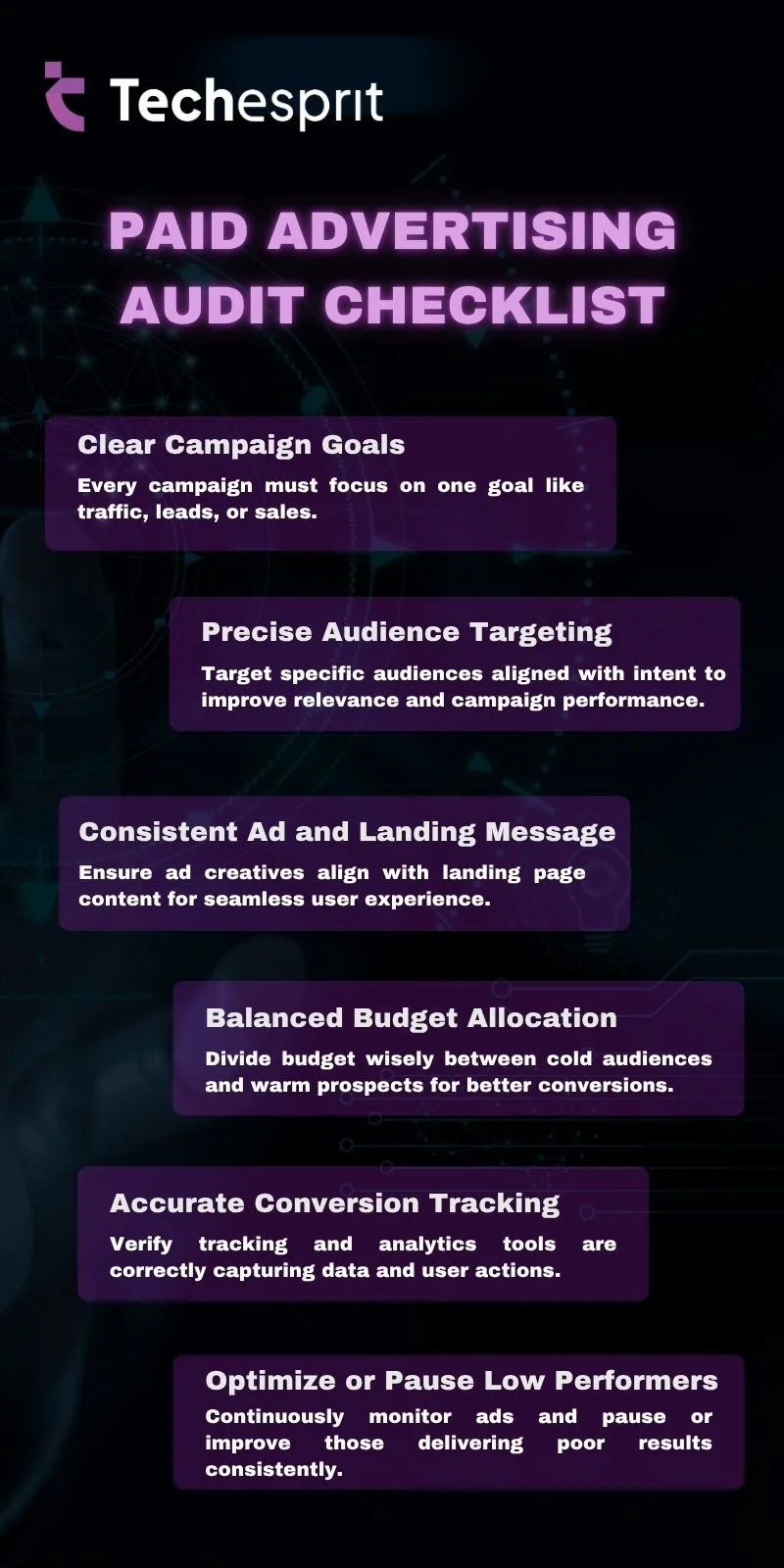
Paid Advertising Audit Checklist
In-House Management vs. Professional Paid Advertising Services
Managing paid advertising in-house is reasonable when campaigns are simple and budgets are limited. It also builds a useful baseline understanding of how platforms operate. However, complexity scales quickly.
Consider bringing in professional paid advertising services when you notice rising costs with no corresponding improvement in conversion rates or ROAS, difficulty isolating what is and is not working across campaigns, or insufficient internal time to manage, test, and optimize consistently.
Outside expertise can reduce inefficiencies significantly, but only when there is a clear strategy already in place. A service without a defined strategy will optimize the wrong things faster.
Conclusion
Paid advertising delivers strong results when waste is identified and removed early. The most common sources of wasted spend, targeting inefficiency, messaging mismatch, poor tracking, and unbalanced budget allocation, are all fixable without increasing your total spend.
A disciplined approach to testing, measurement, and optimization is what separates campaigns that consistently generate returns from those that drain budgets without results. Fix the structure first. The growth follows.
FAQs
What is the biggest mistake in paid advertising?
Poor targeting is the most common and costly mistake. Showing ads to the wrong audience wastes the budget regardless of how large it is or how strong the creative is.
How do I know if my tracking is working correctly?
Use Google Tag Assistant, Meta Pixel Helper, or your platform’s built-in diagnostics to verify conversion events are firing. Check for duplicates, missing events, and broken pixels after any website update.
Are Google Ads or Meta Ads better for my business?
It depends entirely on your product and customer journey. Google Ads works best for capturing existing demand. Meta Ads is more effective for creating demand and reaching audiences who do not know they need your product yet. Many businesses benefit from running both strategically.
How long does it take for paid ads to become profitable?
Most campaigns require four to eight weeks of structured testing and optimization before consistent results appear. Rushing this phase by scaling too quickly typically produces worse outcomes.
What is the best starting point for paid advertising beginners?
Start with one platform, one clear goal, tight audience targeting, and verified conversion tracking in place. Avoid running multiple campaigns simultaneously until you have a baseline of what works.