No. The best current evidence says most people are adding AI tools to the way they search, not dropping Google. What is changing is how often a Google search ends with a click on a website.
If you run a business website, that distinction matters. People have started asking ChatGPT, Gemini, and Perplexity questions they used to type into Google. Google now answers many searches with AI Overviews and AI Mode. Some sites are seeing fewer clicks, and it is easy to assume the two facts are the same story.
They are related, but they are not the same thing. Adopting an AI tool doesn’t mean leaving Google, and a drop in clicks doesn’t prove a drop in demand. This guide goes through the surveys, the click studies, and Google’s own statements, flags where each source is weak, and ends with a way to check whether AI is affecting your own site.
Are People Actually Switching from Google to AI Search?
Mostly, people are doing both. The evidence for a full switch is thin, and the evidence for added AI use is strong.
What Recent Surveys Reveal About Search Behaviour
Three sources give the clearest picture, and each measures something different.
Pew Research Center (fieldwork February 17 to 23, 2026, 5,119 U.S. adults): 42% say they use chatbots to search for information, and 60% say they read AI summaries in search results. Pew reports both as self-described habits.
Similarweb (audience data, September 2025 to May 2026): 95% of ChatGPT users also appear in Google’s audience, the same share as in September 2025. Worldwide visits to generative AI platforms reached 9.5 billion a month in May 2026, up 70% year over year.
Eight Oh Two (500 consumers who already use AI tools, reported by Search Engine Land in January 2026): 37% start searches with AI tools instead of traditional search engines. The same report found that 85% double-check AI answers elsewhere.
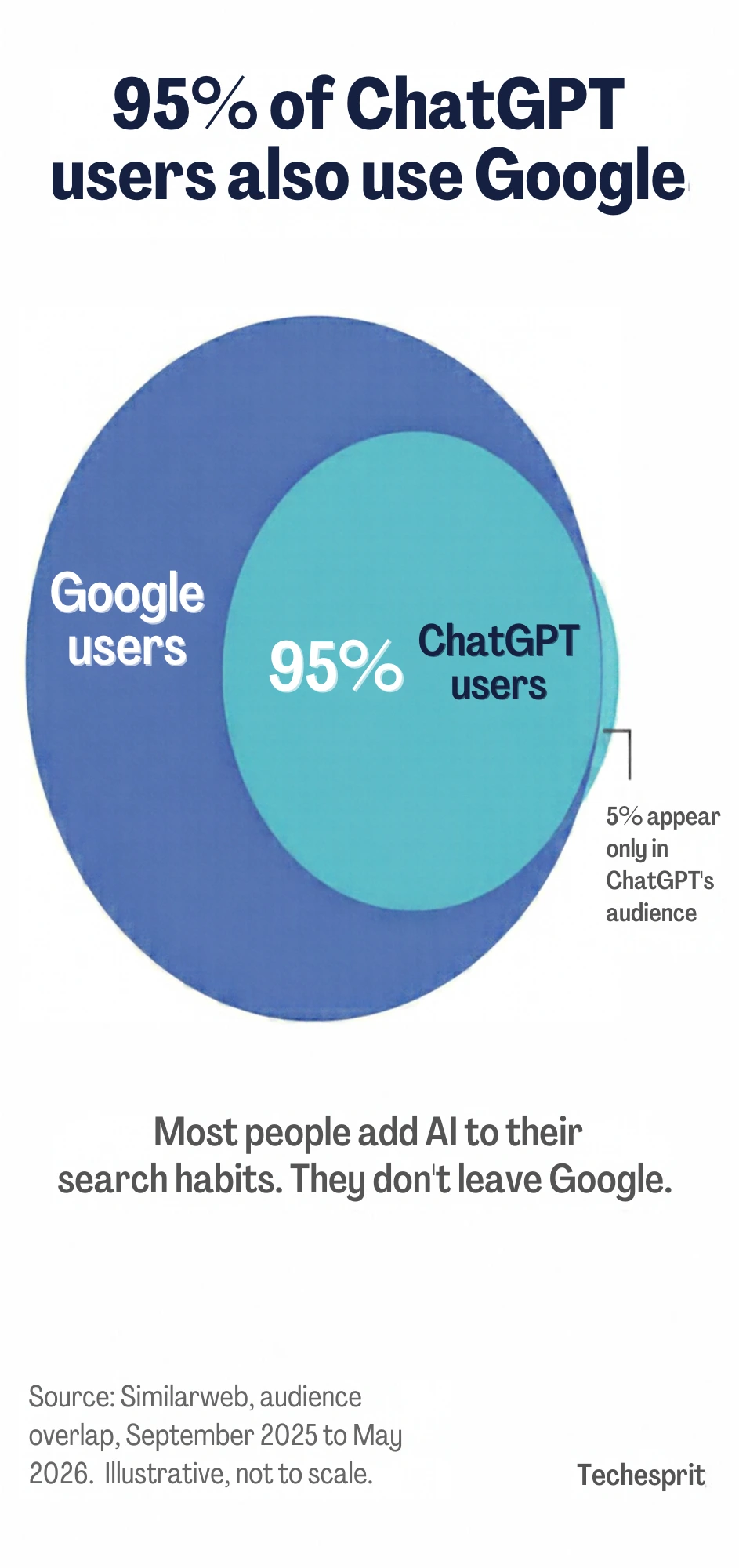
Read these carefully. Similarweb’s 95% overlap shows the same people use both products. It says nothing about how many searches each one gets. The Eight Oh Two sample includes only AI users, so 37% doesn’t apply to the general public, and the study comes from an SEO and PPC agency. Even in that sample, most people did not start with AI.
What the evidence supports
AI adoption is growing fast, and almost everyone who uses ChatGPT still uses Google. “Adding AI” is well supported. “Abandoning Google” is not.
How Google’s Own AI Search Features Change the Picture
Part of the “AI search” trend is happening inside Google. AI Overviews appear above results, and AI Mode is a separate conversational view. In May 2026, Google said AI Mode had passed one billion monthly users, with queries more than doubling every quarter since launch. It also said overall Search queries reached an all-time high the previous quarter.
Google gave no baseline or user-level data behind those statements, so treat them as company claims. They still show why the question “AI or Google?” is getting blurry. A person who asks a long question in AI Mode is using AI and Google at the same moment. Counting that person as someone who left Google would be wrong.
How People Use AI Compared With Traditional Search
The most useful study for displacement is a July 2026 working paper by Shi, Zhu, and Gu, Answering Without Referring. The authors used Comscore clickstream data from U.S. desktop households between October 2024 and July 2025 and compared households before and after they gained access to ChatGPT Search.
| Source | What it measures | Finding | Main caution |
|---|---|---|---|
| Shi, Zhu and Gu, July 2026 | U.S. desktop households, October 2024 to July 2025 | Wider ChatGPT Search access cut traditional search queries by 9.4% on average and 17.0% after twenty weeks | Unreviewed preprint. Desktop only. The authors call their ChatGPT search signal “likely an upper bound” |
| Same paper | Monthly reach among active U.S. desktop households | Google reach stayed near 49%. ChatGPT rose from about 4.6% to a peak near 7.9% | ChatGPT only; other assistants were below 1.5% |
| Similarweb, May 2026 | Visits to generative AI platforms, browser and app | 9.5 billion a month, up 70% year over year | Vendor report. Does not report Google visit totals |
Put together, these point one way. AI use is growing quickly from a small base, and for households that adopt it, a measurable share of traditional searching moves over. Google was not displaced as the default in this period, but its users were searching somewhat less.
How Google AI Overviews Affect Organic Clicks
This is where the strongest evidence of harm sits. Three studies measured clicks in different ways.
| Source | What it measures | Finding | Main caution |
|---|---|---|---|
| Pew browsing study | March 2025 browsing of 900 U.S. adults, 68,879 Google searches | Users clicked a traditional result in 8% of visits with an AI summary and 15% without. Clicks on links inside the summary were 1% of visits. The browsing session ended on 26% of pages with a summary versus 16% without | 18% of searches had a summary in this period, and the data is from early 2025 |
| Ahrefs, February 2026 | 300,000 keywords, desktop Search Console CTR, December 2023 versus December 2025 | Average CTR for the top-ranking page was 58% lower for keywords with an AI Overview | Correlation. The comparison uses a forecast of what CTR would have been without AI Overviews |
| Wang et al., August 2026 | Preregistered field experiment, 1,100 U.S. Chrome users who searched | Forcing AI Mode cut external click-through by 18.8 percentage points. Hiding AI Overviews raised it by 8.8 points | One week. Younger, more educated sample. The hiding tool failed on about half of AI Overviews, and the 8.8 figure rests on an adjustment the authors flag |
The three results are consistent in direction and different in size. That is expected. They cover different time periods, different users, different query sets, and different definitions of “click.” Do not average them or quote one as a universal rate.
Google disagrees with the overall picture. In an August 2025 post, Google’s head of Search said total organic click volume from Search was “relatively stable” year over year, and that average click quality had increased. The post gave no figures or method. Both views can hold at once: total clicks across the web can stay flat while specific sites and query types lose clicks.
Why Are People Using AI Instead of Traditional Search?
People use AI when it removes a step they dislike. The Eight Oh Two report gives the clearest list of what they dislike. Among its AI-using respondents, 40% cited clicking through too many links, 37% too many ads and sponsored results, 33% difficulty getting a straight answer, and 28% repetitive or low-quality information. The sample is limited to AI users, so these figures show why this group chose AI, not how the whole population feels.
Getting Direct Answers and Explanations
The most common reason is a clear explanation. A good AI answer reads like a short briefing. A search results page makes you assemble that briefing from several tabs. In the same report, 60% said AI gives better, clearer answers and 6% said worse. That is a perception, but perception drives habit.
Comparing Products, Services and Options
In the Eight Oh Two sample, 54% had used AI to compare products and 47% had used it to help make a purchase decision. This matters for service businesses, because comparison questions like “WordPress agency versus freelancer” are exactly where an AI answer can name providers before anyone visits a site. The report also says most purchases still happen on retailer or brand sites, so the sale itself usually still needs a website.
Getting Summaries Without Visiting Websites
Many searchers want the answer and not the visit. In Pew’s data, the session ended on 26% of pages with an AI summary compared with 16% of pages with only traditional results. In the Shi, Zhu and Gu paper, ChatGPT produced outbound clicks in only 5.2% of conversation sessions. The authors measured Google differently, using queries and not sessions, so those two rates should not be compared directly. The 5.2% figure shows how rarely an AI conversation hands the user to a website.
Is AI Search Taking Traffic Away from Websites?
For some sites and some query types, yes. For many businesses, the effect is smaller than headlines suggest, and it is easy to misdiagnose.
How AI Answers Can Reduce Organic Clicks
When an answer appears above the results, fewer people need a result. The click studies above show it for Google’s own features, and the displacement paper shows it for ChatGPT Search. The authors of that paper report the largest referral losses in informational categories, which is the kind of queries that suit a direct answer.
Publisher data agrees. Chartbeat figures reported by 9to5Google in March 2026 show Google Search referrals to publishers down 34% over the past year: 60% for small publishers, 47% for medium and 22% for large. That is publisher traffic, not business-site traffic, and the cause is not isolated. Other factors, including core updates, can move the same numbers.
AI Referral Traffic vs Google Organic Traffic
AI tools send very little traffic compared with Google, at least on current data.
The same Chartbeat report says chatbots account for less than 1% of publisher page view referrals, though ChatGPT referrals grew more than 200% during 2025 from a very small base.
The Shi, Zhu and Gu paper found ChatGPT sends outbound clicks in 5.2% of conversation sessions, and that the clicks it does send go more often to specialized sites and less often to ad-supported ones.
So AI referrals cannot replace lost Google clicks today. They are a small, growing channel. Clicks from AI Overviews that land on your site are counted as Google traffic, not AI referrals, which is a reporting problem covered below.
What Zero-Click Searches Mean for Website Owners
A zero-click search is one where the user gets what they need without visiting a site. These have existed for years, through featured snippets, weather boxes, and knowledge panels. AI answers extend them to more complex questions.
For site owners, the practical meaning is that rankings alone no longer guarantee visits. A page can hold position one and receive fewer clicks than before, which is the pattern the Ahrefs study measures. Informational pages that exist only to answer a simple question are most exposed. Pages that support a decision, offer a tool, or lead to a service are less exposed.
Why Fewer Visits Do Not Always Mean Fewer Business Opportunities
Clicks are a means, not the goal. Three things can make a traffic drop less damaging than it looks.
- Clicks are a means, not the goal. Three things can make a traffic drop less damaging than it looks.
- The lost clicks may have been low value. Quick-answer queries rarely turn into enquiries.
- Google says the remaining clicks are better. Its August 2025 post described “quality clicks” as those where users do not quickly return to the results. Google published no data to check this.
- People can be influenced before they click. In the Eight Oh Two sample, 47% said AI influences which brands they trust. A business named in an AI answer can still get a direct visit or branded search later.
The evidence that AI-referred visitors convert better than Google visitors comes mostly from vendor reports, and we have not found a rigorous, independent study. Measure conversions on your own site before you assume either way.
Google Search vs AI Search: Which Is Better for Different Tasks?
Neither is better overall. They fit different jobs.
| Task | Google Search tends to fit when | AI search tends to fit when | Evidence |
|---|---|---|---|
| Informational research | You want several sources side by side or a quick fact | You want an explanation, a summary, or to ask follow-ups | 40% of AI-using respondents were frustrated by too many links; informational categories lose the most referrals. |
| Local searches | You need hours, directions, reviews, a map, or a phone number, such as in local SEO searches | You want advice on how to choose a provider | Techesprit assessment. We found no independent study comparing the two for local intent. |
| Product discovery | You need reviews, prices, specs, and retailer pages | You want to build a shortlist or compare options | 54% of AI-using respondents had used AI to compare products; Search Engine Land’s report says traditional search remained preferred for reviews and pricing. |
| Source verification | You need the source, date, or author | You need help finding what to verify | 85% of AI users double-check AI answers elsewhere. |
The pattern in the data is a split path: people explore or compare with AI, then confirm or buy through search and the destination site. That is why the 95% overlap number is so stable.
What Does the Shift to AI Search Mean for SEO?
It raises the standard for content and measurement. It does not replace the basics.
Why Traditional SEO Still Matters
Google’s own documentation says appearing in AI Overviews and AI Mode depends on ordinary eligibility: a page must be indexed and eligible to be shown in Google Search with a snippet, with no additional requirements.
Google’s AI optimization guide says the work is still SEO. If a page cannot be crawled, indexed, and trusted, it has no route into either result type.
For a closer look at what is and is not supported, read our guide to ranking in AI Overviews and our overview of AI SEO.
Creating Useful, Differentiated Content
If AI answers absorb simple questions, content that only restates common knowledge is the first to lose visits. Content that adds something is harder to replace:
- Original data, tests or screenshots from real work.
- Decision frameworks, checklists and templates.
- Specific experience that a general answer cannot supply, stated only where it is real.
- Clear expertise and authorship, which we cover in our guide to E-E-A-T and AI search.
- Depth across a connected subject, which is the idea behind topical authority.
Maintaining Technical SEO Fundamentals
Technical issues can look like an AI problem.
Check crawlability, indexing, canonicals, structured data that matches visible content, mobile usability, and Core Web Vitals. Our technical SEO guide covers the checks. If the site recently moved or changed platform, review it against our website migration checklist before blaming search changes.
Monitoring Search Visibility Beyond Organic Clicks
Clicks alone now understate visibility. Track these together:
- Impressions and average position in Search Console.
- Click-through rate by page and query group.
- Branded search demand.
- Referral sessions from identifiable AI platforms.
- Enquiries, calls and qualified leads.
Keep them in separate columns. An AI citation you spotted in one screenshot isn’t a trend, and an increase in impressions isn’t a lead.
How to Tell Whether AI Search Is Affecting Your Website
Do not assume. A traffic drop can have many causes, and AI is only one. Work through these checks in order.
Analyse Google Search Console Performance
Google says AI feature traffic is included in Search Console’s overall search traffic and reported in the Performance report under the Web search type. The documentation does not describe a filter that isolates AI features, so you infer their effect from patterns, not from a dedicated report.
- Open Performance, Search results, and compare the last 12 to 16 weeks with the previous period and the same period last year.
- Look at clicks, impressions, CTR, and average position together.
- Break the data down by page and by query, grouped by intent (informational, commercial, branded).
- Note where the change is concentrated. A site-wide drop and a drop on ten how-to articles are different problems.
Separate Ranking Losses from CTR Declines
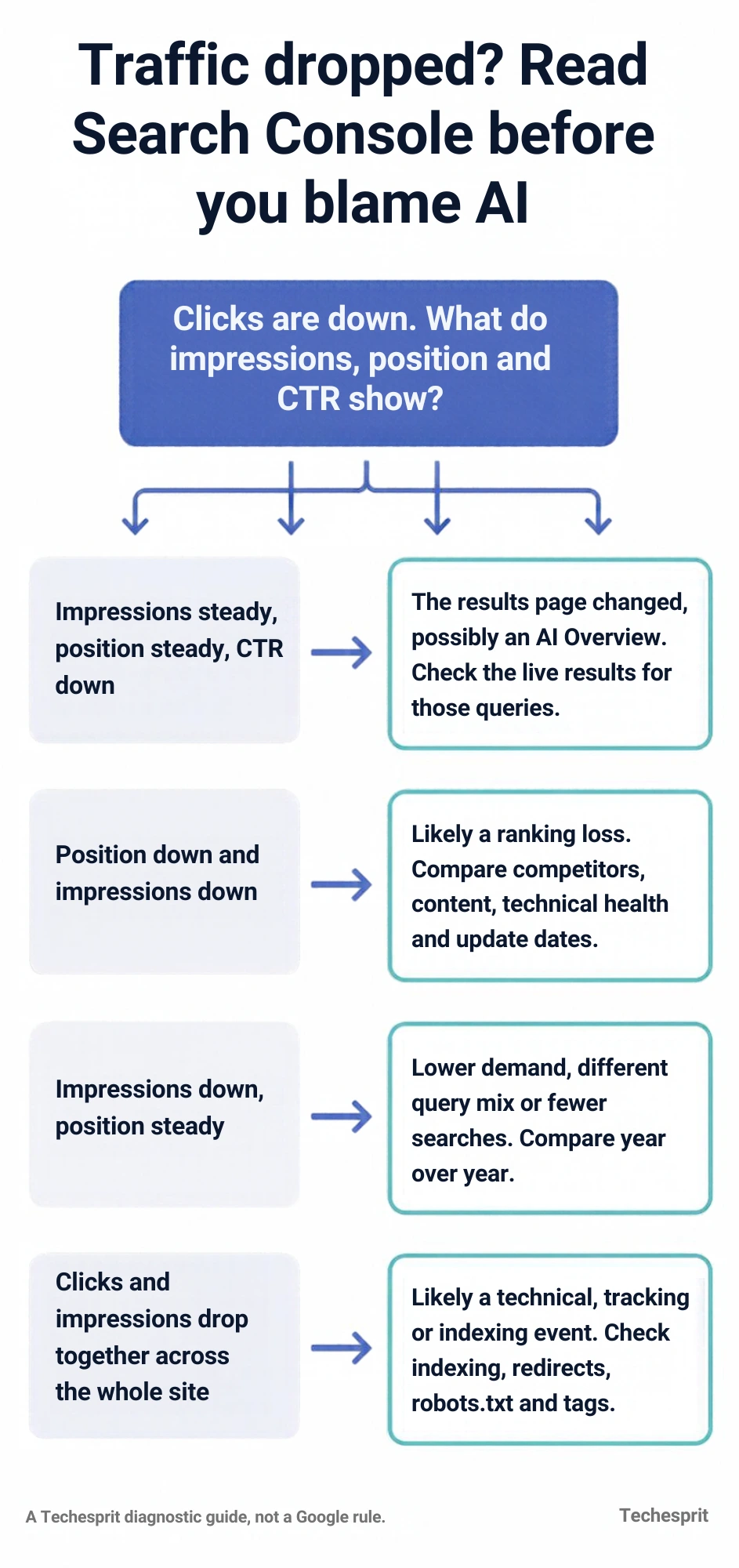
This is the most useful distinction. The table below is our diagnostic guide, not a Google rule.
| What you see | Likely reading | What to do next |
|---|---|---|
| Impressions steady, position steady, CTR down | The results page changed, possibly an AI Overview or other feature | Check the live results for those queries |
| Position down and impressions down | A ranking loss | Compare competitors, content and technical health; check update dates |
| Impressions down, position steady | Lower demand, a change in query mix, or fewer searches | Compare year over year and check search trends |
| Clicks and impressions drop together across the whole site | A technical, tracking, or indexing event | Check indexing, redirects, robots.txt, and analytics tags |
Check SERP Features for Important Queries
Pick your 20 to 30 most valuable queries. Search each one yourself in a private browser window and record what appears: an AI Overview, whether your site is cited, featured snippets, People Also Ask, local packs, video and shopping results. Results vary by location and over time, so repeat the check monthly and keep dated notes. This gives you evidence for the cases the numbers cannot explain.
Measure AI Referral Traffic and Conversions in GA4
GA4 does not label AI assistants as their own channel by default. Google’s help page explains how to create a custom channel group: go to Admin, Data display, Channel groups, create a new group, add a channel whose condition matches the source against a regex pattern, and move it above Referral so it is processed first.
Check which source names appear in your own Traffic acquisition report before writing the pattern. A starting point is:
chatgpt\.com|chat\.openai\.com|perplexity|gemini\.google\.com|copilot\.microsoft\.com|claude\.ai
Treat this as a template that needs review, because source names change. Two limits apply. Some AI tools and browsers do not pass referrer data, so part of the traffic will show as direct. Clicks from Google’s AI Overviews and AI Mode appear as Google organic, not as AI referrals. Then compare key events and leads for the AI channel against organic search, using your own numbers.
Investigate Other Causes of Traffic Declines
Rule out the other explanations before you decide AI is the cause. Google’s Search Status Dashboard lists these 2026 updates (end dates are approximate):
| Update | Start | Approximate end |
|---|---|---|
| March 2026 spam update | March 24 | March 25 |
| March 2026 core update | March 27 | April 8 |
| May 2026 core update | May 21 | June 2 |
| June 2026 spam update | June 24 | June 26 |
| August 2026 spam update | August 18 | August 21 |
| September 2026 spam update | September 24 | October 8 |
Also check for seasonality, a recent redesign, migration or plugin change, tracking or consent changes, lost backlinks, new competitors, and indexing problems. If the timing matches an update, review the content and site quality questions before you attribute the loss to AI.
How Can Businesses Prepare for the Future of Search?
Nobody can promise results from AI search, so prepare by strengthening what is already measurable.
- Fix the baseline. Make sure key pages are crawlable, fast, accurate, and clearly structured. Our WordPress SEO guide covers the checks for WordPress sites.
- Protect pages that earn leads. Identify the pages that produce enquiries and put your best content effort there.
- Make content harder to replace. Add original examples, process detail, data, and honest limitations.
- Keep business information consistent. Names, services, locations, and profiles should match across your site and listings.
- Set up the measurement above. Search Console baselines, a GA4 AI channel, and a lead record you trust.
- Review quarterly. Check your top queries for SERP changes and update pages when the facts change.
Do not chase unsupported tactics. Google’s guidance says no special files or markup are needed for its AI features, and our guide to AI SEO covers the advice to be wary of.
Final Verdict: Are People Really Leaving Google for AI?
Not in the way the headlines suggest. The data shows people adding AI tools to their habits while keeping Google, with 95% of ChatGPT users still appearing in Google’s audience. The measurable shift is narrower: some traditional searches move to AI, and AI answers reduce the share of searches that end in a website click, especially for informational queries.
For a business, the risk is not that Google disappears. It is that rankings convert to fewer visits for the easiest questions. The response is to publish content worth visiting, keep the technical base sound, and measure leads, not clicks alone.
The evidence will keep changing. Several of the studies above are unreviewed, vendor-produced, or limited to U.S. desktop users, so use them as direction, not as fixed rates.
Seeing fewer clicks and not sure why?
Send us your site and the pages that dropped. We will check Search Console, indexing, and the live results to tell you whether it is a ranking loss, a click-through change, or something else.
Our WordPress SEO services include this kind of diagnosis.