E-E-A-T stands for Experience, Expertise, Authoritativeness, and Trust. It is the framework Google’s quality raters use to judge search results. Google says it is not a specific ranking factor, and that trust matters most.
For E-E-A-T and AI search, Google documents no extra requirements. A page must be indexed and eligible to show with a snippet. E-E-A-T still earns its place: it is how you prove a page deserves trust, whether a person or an AI answer reads it.
Below: what Google actually says, what to do about it, and a checker you can run yourself.
A note on evidence. AI search advice is full of confident claims with no source. We tag claims as Google-confirmed (stated in Google’s own pages), practitioner observation (patterns reported by SEO teams, not guaranteed), or our recommendation (our judgment). Where a claim sits matters, so we say so.
| Question | Short answer |
|---|---|
| Is E-E-A-T a ranking factor? | Google says it is not a specific ranking factor, but the signals that show it are useful. |
| Is there an E-E-A-T score? | Not one Google publishes. Any score you see comes from a tool vendor’s own model. |
| Does it matter for AI search? | Google lists no AI-specific requirements. E-E-A-T is part of its helpful content guidance, so the link is indirect. |
| Are there Chrome-specific rules? | Google has published none. |
| Is there an official checker? | No. A manual audit below does the useful part. |
What Is E-E-A-T?
E-E-A-T is a set of four qualities Google’s human quality raters look for when they judge a page. The rater guidelines say Experience, Expertise, Authoritativeness, and Trust are “all important considerations” in rating page quality.
Each letter asks a different question:
| Part | What the rater guidelines ask | What it looks like on a page |
|---|---|---|
| Experience | Does the creator have “first-hand or life experience for the topic”? | Original screenshots, test notes, real client results |
| Expertise | Does the creator have “the necessary knowledge or skill for the topic”? | Named author, relevant credentials, accurate detail |
| Authoritativeness | Is the creator or site “known as a go-to source for the topic”? | Mentions, citations, and links from other trusted sources |
| Trust | Is the page “accurate, honest, safe, and reliable”? | Cited sources, contact details, HTTPS, clear disclosures |
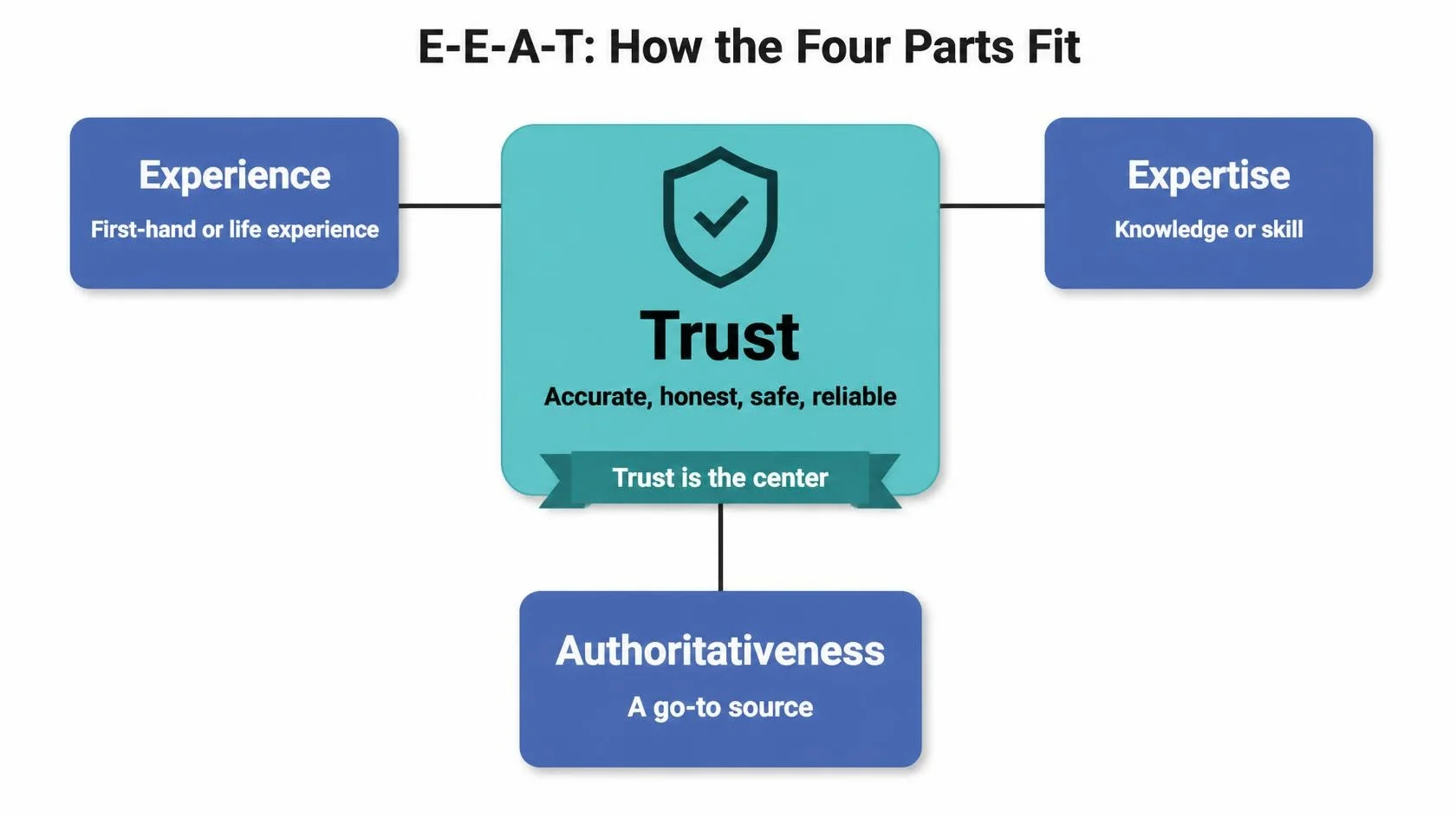
Source: Google Search Quality Rater Guidelines, September 11, 2025 version, the latest we could access.
E-E-A-T Principles: Trust Comes First
Five principles hold up across every source we checked.
Trust sits at the center. The rater guidelines say “untrustworthy pages have low E-E-A-T no matter how Experienced, Expert, or Authoritative they may seem.”
You do not need all four. Google’s own page says trust is most important, and that “content doesn’t necessarily have to demonstrate all of them.”
Match proof to risk. The rater guidelines call topics that can affect health, money, or safety Your Money or Your Life (YMYL). Those need stronger proof of expertise. A recipe blog does not.
Show, do not claim. “Trusted expert” is a claim. A named author, a dated test, and a cited source are proof. (Our recommendation.)
Earn authority off your own site. Nobody becomes a go-to source by saying so. Others have to say it. (Our recommendation.)
E-E-A-T Guidelines: What Google Actually Publishes
Google publishes no single “E-E-A-T guide.” The guidance is spread across four documents, written for different readers.
| Document | What it says | Version we checked |
|---|---|---|
| Search Quality Rater Guidelines | Defines each E-E-A-T part and puts trust at the center. Written for raters. | September 11, 2025 |
| Creating helpful, reliable, people-first content | Says E-E-A-T is not a specific ranking factor. Gives the Who, How, and Why questions. Written for site owners. | Updated October 5, 2026 |
| AI features and your website | States the eligibility rule for AI Overviews and AI Mode. | Updated December 10, 2025 |
| AI optimization guide | Calls optimizing for generative AI search “still SEO.” | Updated July 10, 2026 |
The most useful part for writers is the Who, How, and Why framework from Google’s helpful content page:
- Who: “Is it self-evident to your visitors who authored your content?”
- How: It is “helpful to readers to know how a piece of content was produced.”
- Why: “The ‘why’ should be that you’re creating content primarily to help people.”
Treat those three questions as the working E-E-A-T guidelines. Every signal below answers one of them.
Is E-E-A-T a Ranking Factor?
Google-confirmed: no, not as a specific factor. Google’s helpful content page says: “While E-E-A-T itself isn’t a specific ranking factor, using a mix of factors that can identify content with good E-E-A-T is useful.”
Read that closely. Google is not saying E-E-A-T is irrelevant. It is saying you cannot point to a single “E-E-A-T signal” in the algorithm. You build the underlying qualities and let the many systems that measure them do their job.
E-E-A-T Score: Is There One?
There is no E-E-A-T score in Google’s public documents. Neither the rater guidelines nor the helpful content page publishes one, and Google says E-E-A-T is not a specific ranking factor.
So where do the scores come from? Tool vendors. Their numbers are their own models, built from signals they can crawl. They can be a useful to-do list. They are not Google’s opinion of your site.
E-E-A-T Signals: What to Put on the Page
A signal is anything on or about a page that helps a reader, or a system, judge whether to trust it. Here are the ones worth the effort, mapped to the part they support.
| Signal | Supports | Evidence level |
|---|---|---|
| Named author with a relevant bio | Expertise, Experience | Google-confirmed (the “Who” question) |
| A note on how the content was made, including AI use | Trust | Google-confirmed (the “How” question) |
| Content built to help people, not to catch rankings | Trust | Google-confirmed (the “Why” question) |
| Original photos, data, test notes, case studies with numbers | Experience | Our recommendation |
| Linked primary sources for every statistic | Trust | Our recommendation |
| About page, contact details, policies, HTTPS | Trust | Our recommendation |
| Visible published and updated dates | Trust | Our recommendation |
| Mentions and links from other trusted sites | Authoritativeness | Practitioner observation (see the Ahrefs data below) |
Notice what is missing: a magic markup tag. Google says structured data “isn’t required for generative AI search” and that there is no special schema.org markup to add. Schema helps machines parse a page. It does not prove you are trustworthy.
E-E-A-T and AI Search on Google: What Is Confirmed
People type “E-E-A-T and AI search Google” hoping for a rule. Here is the rule, and it is shorter than most guides admit.
Google-confirmed: to appear as a supporting link in AI Overviews or AI Mode, “a page must be indexed and eligible to be shown in Google Search with a snippet.” Google adds: “There are no additional requirements to appear in AI Overviews or AI Mode, nor other special optimizations necessary.”
That makes E-E-A-T a quality layer, not a gate. Think of two layers:
- Eligibility layer: crawlable, indexed, snippet-eligible. Without this, nothing else matters.
- Trust layer: the E-E-A-T proof that makes your page worth pulling into an answer.
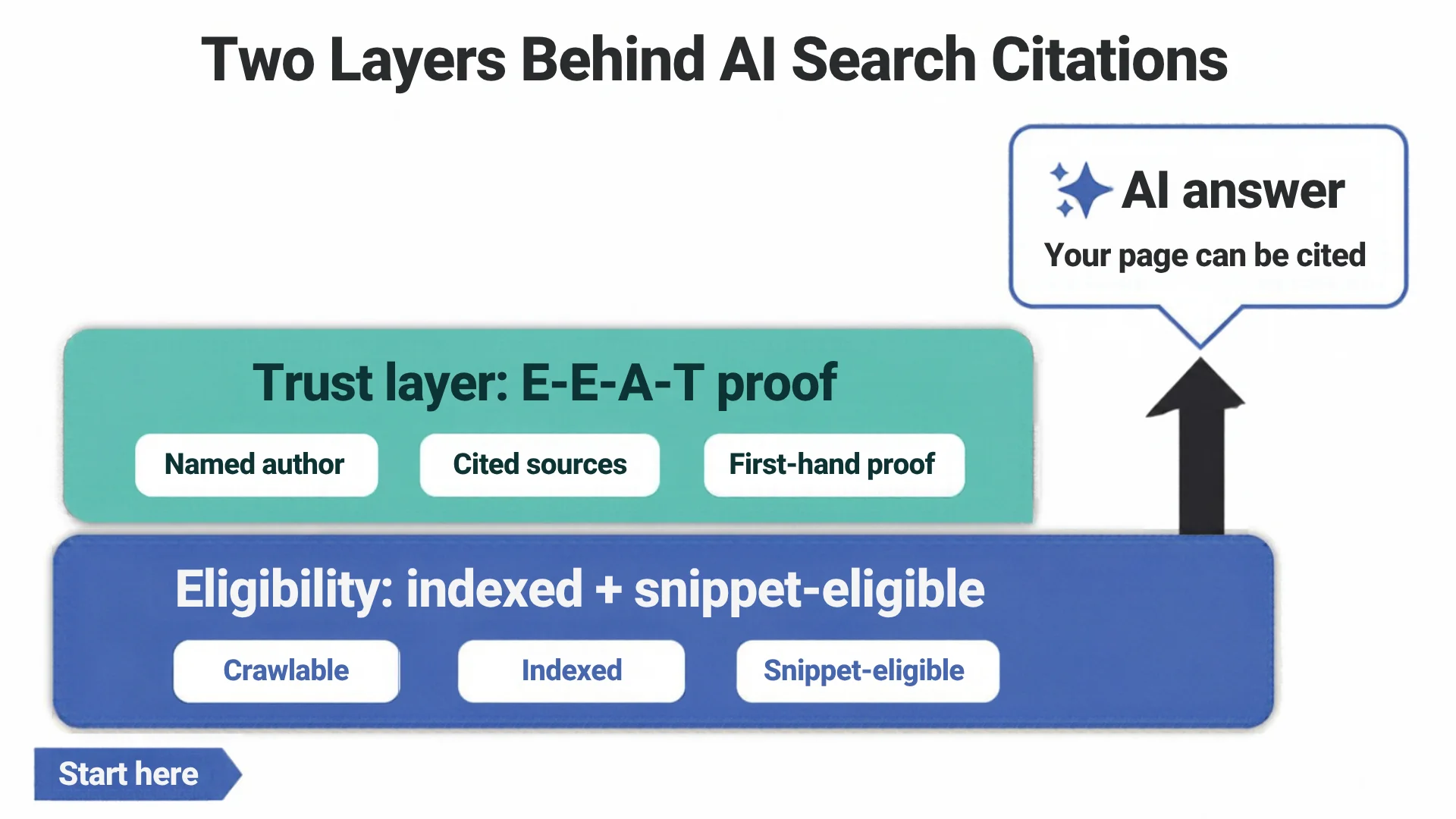
Our recommendation: do the bottom layer first.
Related reading: How to Rank in AI Overviews covers the eligibility layer, including crawling, indexing and how to track AI Overview impressions in Search Console.
What the data says about authority and AI citations
Practitioner observation: Ahrefs studied 75,000 brands to see what correlates with a brand being mentioned in Google’s AI Overviews. These are its Spearman correlations:
| Factor | Correlation with AI Overview mentions |
|---|---|
| Branded web mentions | 0.664 |
| Branded anchors | 0.527 |
| Branded search volume | 0.392 |
| Domain Rating | 0.326 |
| Referring domains | 0.295 |
| Backlinks | 0.218 |
Source: Ahrefs, AI Overview brand visibility factors.
Three cautions. The authors say “correlation ≠ causation.” They also call every factor a moderate to very weak correlation. And the study measures brand mentions, not E-E-A-T.
Our reading: authoritativeness means being “known as a go-to source,” and brand mentions are one visible form of that. That is an interpretation, not a finding.
E-E-A-T and AI Search in Chrome: What Google Has Not Said
People also search “E-E-A-T and AI search Chrome.” The honest answer is that Google has published no Chrome-specific rules.
Google-confirmed: Google’s Chrome announcement of September 18, 2025 describes two features:
Gemini in Chrome, an assistant that “can answer questions about articles” and works across tabs.
AI Mode in the omnibox, which lets people “ask complex, multi-part questions” and “explore relevant web links.”
The post does not explain how sites are chosen or cited. It says nothing about E-E-A-T.
Our inference, not confirmed: AI Mode in the address bar looks like the AI Mode feature from Search, reached through the browser. If so, the eligibility rule above applies. Google has not said this outright.
What to do about it:
Write pages an assistant can read. If Gemini answers questions about your article, clear headings and direct answers make that easier.
Keep who, how, and why visible. An assistant summarizing your page can only repeat what the page shows.
Do not optimize “for Chrome.” There is nothing documented to optimize for.
E-E-A-T AI: Does AI-Written Content Meet E-E-A-T?
It can, if people stay responsible for it. Google does not ban AI content. It bans using it to manipulate rankings.
Google-confirmed: “If you use automation, including AI-generation, to produce content for the primary purpose of manipulating search rankings, that’s a violation of our spam policies.” The rater guidelines also treat scaled content abuse as a Lowest-rating characteristic.
Our rule is simple. AI can draft. People supply the experience, check every claim, and own the result. A model has not tested your plugin, run your audit, or served your client. Only you can add that.
This is why our byline discloses AI assistance. It answers Google’s “How” question in one line.
E-E-A-T in Content Writing: A Working Process
Build the proof before you write the page. This is the process we follow.
- Pick topics you can prove. Choose subjects where you have first-hand work, or can get it.
- Name the author. Add a one-line reason they are qualified and link a bio page.
- Gather evidence first. Collect screenshots, test notes, data, and client results before drafting.
- Lead with the answer. State the answer in the first sentences, then show the evidence.
- Cite primary sources. Link every statistic to where it came from.
- Say how it was made. Mention testing, sources, and any AI assistance.
- Date it and update it. Show the dates. Revise when facts change.
- Get a qualified review. Especially for YMYL topics.
Here is the difference in practice. The wording below is illustrative, not a claim about a real test.
| Part | Weak | Stronger |
|---|---|---|
| Experience | “Caching improves speed.” | “On a staging copy of a client store, we compared three caching setups and recorded Largest Contentful Paint for each.” |
| Expertise | Byline reads “Admin.” | Named author, role, and a link to a profile page. |
| Authoritativeness | “We are the best agency.” | Cited by other sites, listed in industry directories, quoted by name. |
| Trust | No dates, no sources, no contact page. | Dated updates, linked sources, visible contact details, and disclosures. |
E-E-A-T Examples You Can Check Yourself
A real result with numbers. We documented a six-month SEO and WooCommerce rebuild for RackKing. Search Console clicks rose from 36 to 104, and impressions from 2,240 to 18,400. That is Experience shown as data, not adjectives.
One caveat: that result came from combined technical and content work. We do not claim E-E-A-T alone produced it.
See the numbers: RackKing case study, custom WooCommerce rebuild, and SEO strategy.
A trust signal in plain sight. Every Google page cited in this guide shows a “last updated” date. That is a small, checkable trust signal, and the date is what lets us tell you which versions we read.
A disclosure. The byline above names the author, states that AI assisted the draft, and says a team fact-checked it. That answers “Who” and “How” before the first paragraph.
E-E-A-T Checker: Is There One?
There is no official E-E-A-T checker from Google. A search for the term returns many free tools that output a score. We have not tested them, so we name none.
Here is what such a tool can and cannot do:
- It can detect surface elements: an author box, a contact page, schema, HTTPS.
- It cannot judge whether your experience is real, whether your claims are accurate, or whether anyone treats you as a go-to source.
A tool is a useful to-do list. It is not a verdict. A manual audit does the part a tool cannot.
A manual E-E-A-T checker you can run in an hour
Pick your five most important pages. Check each against this list. Pass or fail, no scoring.
| # | Check | Where to look | Part |
|---|---|---|---|
| 1 | A named author appears on the page | Byline | Expertise |
| 2 | The author page shows real, relevant credentials | Author profile | Expertise |
| 3 | The page contains evidence only a practitioner would have | Body | Experience |
| 4 | Every statistic links to a primary source | Body, sources | Trust |
| 5 | The page states how it was made, including AI use | Byline or intro | Trust |
| 6 | Published and updated dates are visible and honest | Header | Trust |
| 7 | Contact details, About page, and policies are easy to find | Footer, menu | Trust |
| 8 | The site runs on HTTPS with no browser warnings | Browser bar | Trust |
| 9 | No claim goes beyond the evidence (no guaranteed results) | Body, CTAs | Trust |
| 10 | Other trusted sites mention or cite you by name | Search, link reports | Authoritativeness |
| 11 | The page is indexed and shows with a snippet | Search Console URL Inspection | AI eligibility |
Any “fail” is a to-do. Fix the trust items first, since Google’s own guidance puts trust at the center.
E-E-A-T Mistakes That Waste Effort
- Chasing an E-E-A-T score. Google does not publish one, so you would be optimizing a vendor’s guess.
- Inventing author credentials. A fake bio is a trust failure. Trust is the part Google puts at the center.
- Claiming experience with no evidence. “In my experience” means nothing without a test, a number, or a screenshot.
- Adding schema and expecting AI citations. Google says no special markup is needed for generative AI search.
- Publishing AI drafts unreviewed. Scaled, unchecked content is exactly what the rater guidelines flag.
- Buying links or mentions with nothing worth citing behind them. Authority follows substance.
- Ignoring sitewide trust. Strong articles on a site with no contact page or policies send mixed signals.
What to Do Next
E-E-A-T and AI search come down to one job: make it obvious who wrote the page, how it was made, and why it can be trusted. Do that on your five most important pages first.
Then confirm the pages are indexed and snippet-eligible. Google lists nothing beyond that, and nobody outside Google can promise a citation.
Want an outside check of your E-E-A-T and AI search readiness?
We review your author pages, trust signals, indexing and AI eligibility against Google’s own documents, then tell you what to fix first. No guaranteed rankings, just a clear list.
Continue reading: AI SEO: How to Optimize for AI Search Without llms.txt for the eligibility layer, Topical Authority for building proven depth on a subject, and Technical SEO for crawling and indexing. Working on WordPress? See our WordPress SEO guide.