A note on evidence in this guide. AI search is young enough that a lot of what’s published about it is unverified opinion dressed up as fact. Throughout this piece, we separate four kinds of claims: Google-confirmed (stated directly in Google’s own documentation), academic research (peer-reviewed findings, cited by name), practitioner observation (patterns reported by SEOs tracking real sites, not guaranteed to generalize), and our recommendation (our own judgment based on the above). Where a claim falls matters, and we say so as we go.
Most “AI SEO” content being published right now does one of two things: it either treats AI search as a completely new discipline requiring new files and new tactics, or it’s a sales page for an agency with no real explanation underneath. Neither is accurate. Google published its own direct guidance on this in 2026, and it says something more measured than almost anyone selling “AI SEO services” wants to repeat.
What Is AI SEO Optimization?
AI SEO is the practice of making a website’s content easier for AI systems, Google’s AI Overviews and AI Mode, ChatGPT, Perplexity, Claude, and similar tools, to find, understand, and cite when answering a user’s question. It sits inside SEO rather than replacing it: the same signals that help a page rank in traditional search (clear structure, genuine expertise, technical accessibility, authoritative sourcing) are largely the same signals that determine whether a page gets pulled into an AI-generated answer.
Google-Confirmed
Google’s own AI search optimization guide states directly: “From Google Search’s perspective, optimizing for generative AI search is optimizing for the search experience, and thus still SEO.” The guide goes further, stating plainly that sites don’t need new machine-readable files, AI-specific text files, special markup, or Markdown to appear in Google Search or its AI features, and that structured data “isn’t required for generative AI search.” Source: Google Search Central, AI optimization guide, last updated July 10, 2026.
That single document is worth building this entire guide around, because it directly contradicts a claim repeated across several competing “AI SEO” guides: that a dedicated llms.txt file is a meaningful ranking or citation lever. It isn’t, by Google’s own stated position. We cover that specific claim, and who’s making it, further down.
The term itself has an academic origin worth knowing. “Generative Engine Optimization” (GEO) was formally coined in a 2024 research paper,GEO: Generative Engine Optimization from Princeton University, Georgia Tech, the Allen Institute for AI, and IIT Delhi, presented at KDD 2024. The paper proposed and tested methods for improving content visibility specifically inside generative AI answers, distinct from traditional ranking. “AI SEO” has since become the more common umbrella term in marketing use, often covering the same ground as GEO plus the older term AEO (Answer Engine Optimization, originally associated with voice search and featured snippets).
How Does Generative Engine Optimization Work?
Generative engine optimization works by influencing two separate mechanisms most AI search tools rely on: how your content gets selected into the pool of sources an AI system draws from, and how the system decides what to pull from that pool once a question arrives.
Retrieval-Augmented Generation (RAG) is the first mechanism. Rather than answering purely from what a language model memorized during training, most AI search tools, including Google’s AI Overviews, retrieve a set of live, current web pages relevant to the query at the moment it’s asked, then generate an answer grounded in that retrieved content. This is Google-confirmed: Google’s own documentation on AI features describes AI Overviews as grounded in web search results, not purely in the model’s training data. Practically, this means a page needs to already be indexable, crawlable, and genuinely relevant to a query to even enter the pool an AI system can draw from; no amount of “AI optimization” helps a page that isn’t indexed in the first place.
Query fan-out is the second mechanism. When an AI system processes a query, it frequently breaks that single query into several related sub-queries internally, runs retrieval against each, then synthesizes a single answer from the combined results. This is documented directly in Google’s own AI features documentation. A search for “how to speed up a WordPress site” might internally fan out into sub-queries like “WordPress caching plugins,” “Core Web Vitals WordPress,” and “image optimization WordPress,” and a page that ranks well across several of those related sub-queries has meaningfully more chances to be pulled into the final answer than a page that only targets the single head term.
| Platform | Primary Retrieval Source | What This Means for You |
|---|---|---|
| Google AI Overviews / AI Mode | Google’s own search index, live | Standard SEO fundamentals apply directly: if it can’t rank traditionally, it won’t get cited here either |
| ChatGPT (with browsing/search) | Bing index plus live retrieval, OAI-SearchBot | Bing Webmaster Tools and Bing indexing matter here, not just Google Search Console |
| Perplexity | Live web retrieval, PerplexityBot | Must allow PerplexityBot in robots.txt to be eligible for retrieval at all |
| Claude (with web search) | Live web retrieval, Claude-SearchBot | Same principle: crawler access is a precondition, not a ranking factor on its own |
That last column matters more than it looks. A meaningful share of “AI SEO” problems we see are not optimization problems at all; they’re access problems: a robots.txt file blocking a retrieval crawler, or a site serving AI crawlers a different, broken response than it serves Googlebot. Worth distinguishing two different categories of AI crawlers before you touch robots.txt: training crawlers (GPTBot, ClaudeBot, Google-Extended) collect content to train future models and can reasonably be blocked without affecting your current search or AI-citation visibility; retrieval crawlers (OAI-SearchBot, Claude-SearchBot, PerplexityBot, and Googlebot itself) fetch content live to answer a specific query, and blocking these directly removes you from that platform’s citation pool. Confusing the two is one of the more common technical mistakes we see.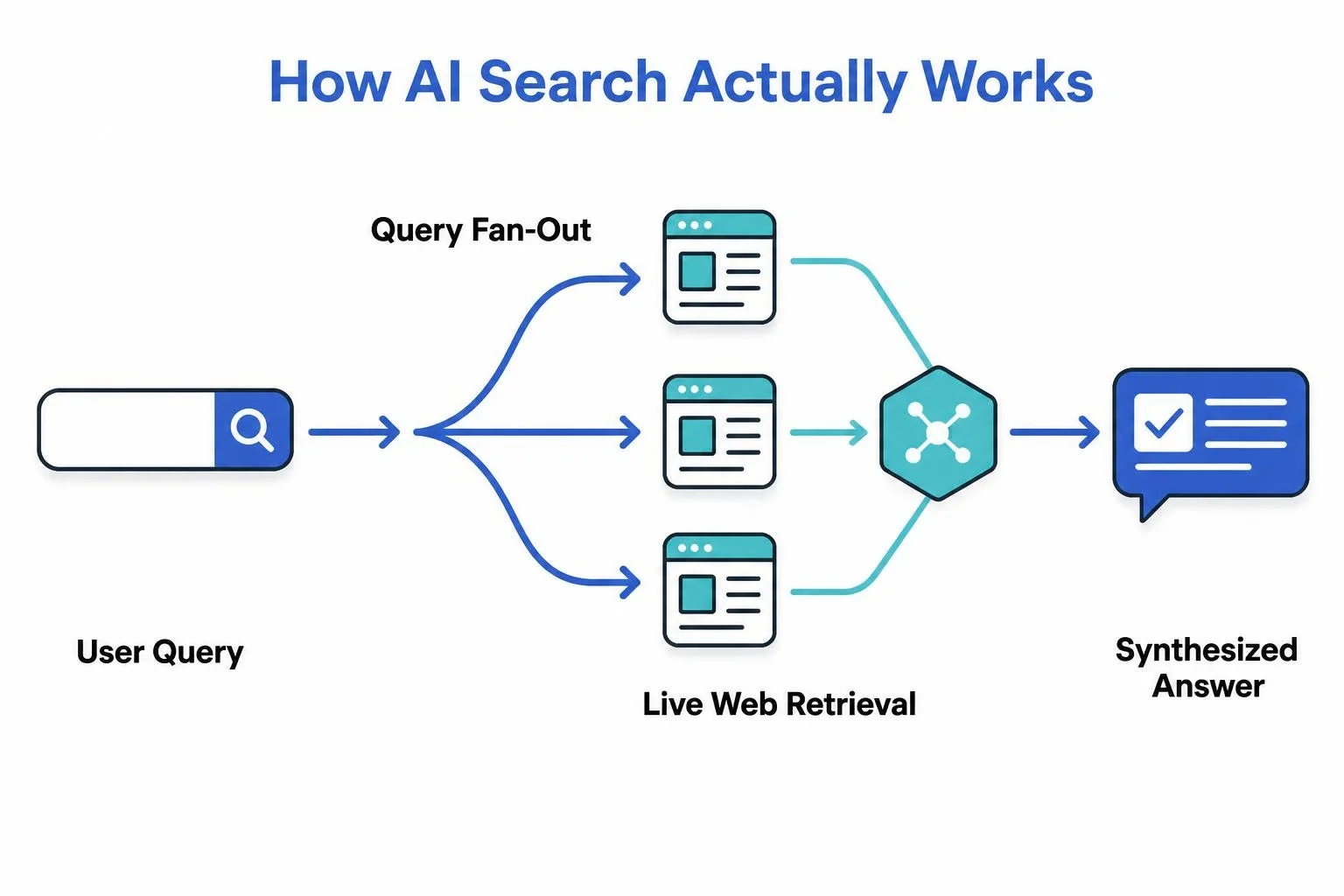
What Are the Benefits of Generative Engine Optimization?
The honest case for AI SEO isn’t that it replaces traditional organic traffic; it’s that it adds a visibility channel traditional rankings don’t fully cover, while reinforcing fundamentals that help traditional SEO anyway.
Visibility at the point of decision, not just the point of search. When a user gets a synthesized answer with your business cited as a source, they see your name and your claim before clicking anything. That’s brand exposure even on queries where they never visit your site, comparable to how a featured snippet works today, just with more surface area.
It rewards the same fundamentals good SEO already requires. Nothing in the GEO research or Google’s own documentation describes a shortcut around expertise, clear writing, or technical accessibility. Practitioner observation across multiple SEO teams tracking AI citation consistently points to the same baseline: pages with clear direct answers, genuine authorship, and current information get cited more often, which is also what helps a page rank traditionally. Investing in GEO is largely investing in doing SEO properly, not a separate budget line.
It surfaces technical problems traditional rank tracking can miss. A site with a broken robots.txt entry for a retrieval crawler, or JavaScript-rendered content a bot can’t parse, might still show reasonable traditional rankings while being functionally invisible to AI citation. Auditing for AI SEO specifically catches that gap.
Early positioning in a channel still forming. This is our recommendation, not a confirmed metric: AI Overviews and AI Mode citation patterns are still stabilizing, and topics with less competitive density in AI citation right now may be easier to establish authority in than in traditional search results that have been competed over for a decade. That advantage narrows as more sites compete for the same AI visibility, so it’s a reason to start now rather than wait, not a guaranteed permanent edge.
What it doesn’t do: guarantee traffic, guarantee a citation on any specific query, or replace the need for traditional SEO. Anyone promising a specific AI Overview placement is promising something outside anyone’s direct control; Google’s own documentation describes AI Overviews as dynamically generated per query, not a static ranking position.
AI SEO vs. Traditional SEO
| Traditional SEO | AI SEO / GEO | |
|---|---|---|
| Goal | Rank in the list of results | Get cited inside a generated answer |
| Core mechanism | Indexing + ranking algorithm | Indexing + retrieval (RAG) + synthesis |
| Measurable position | Stable rank per query (within normal fluctuation) | Non-deterministic, can vary between refreshes of the same query |
| Required new markup | Standard Schema.org as applicable | None, per Google’s own guidance (no special AI schema) |
| Primary tracking tool | Search Console, rank trackers | Search Console (AI Overview filter) + dedicated multi-platform citation tools |
How to Optimize for AI SEO
Confirm crawler access before anything else
Check robots.txt for Googlebot, OAI-SearchBot, PerplexityBot, and Claude-SearchBot specifically, rather than assuming a generic allow-all rule covers them. If content relies on client-side JavaScript to render, verify it’s also present in server-rendered HTML; several retrieval crawlers can’t reliably execute JavaScript the way a browser does.
Lead every page with a direct, complete answer
The first two to three sentences after a heading should fully answer the question that heading poses, before any supporting context. This is the single pattern most consistently associated with both featured-snippet and AI-citation success in practitioner observation, and it’s also just better writing for a human reader in a hurry.
Structure content so a passage can stand alone
AI systems extract specific passages, not full pages. A paragraph that depends on three paragraphs of prior context to make sense is harder to extract cleanly than one that’s self-contained. Clear H2/H3 headers that match real questions, with the answer directly beneath, make extraction easier without changing a word of the actual writing style.
Demonstrate genuine authorship and currency
Real author bylines with real credentials, visible publish and update dates, and content that’s actually kept current rather than published once and abandoned, all signal the kind of trustworthiness both traditional ranking and AI citation reward. This is the same E-E-A-T foundation as traditional SEO, not a separate requirement.
Build topical depth through real content clusters, not isolated pages
A single standout page gives an AI system one passage to evaluate for a topic. A genuine cluster of related, interlinked pages gives it multiple strong passages across multiple related sub-queries from the same fan-out, which meaningfully increases the number of ways your content could get pulled into an answer. We cover what actually counts as a real cluster, and what Google’s own systems can verify about it, in our guide to topical authority
Also Read
These five tactics overlap substantially with what gets a page into Google’s AI Overviews specifically. We go deeper on fan-out query targeting, content-length research, and AI Overview tracking tools in our complete guide to ranking in AI Overviews, including a correction to a widely circulated but inaccurate Core Web Vitals claim.
What Tools Are Available for Generative Engine Optimization?
| Category | What It Does | Free Option Available |
|---|---|---|
| AI Overview visibility tracking | Shows which of your pages appear in Google’s AI Overviews and generate impressions | Yes, Google Search Console (Performance report, filtered by search type) |
| Multi-platform citation monitoring | Tracks whether and how often a brand is cited across ChatGPT, Perplexity, Claude, and Gemini, not just Google | No, paid category (multiple vendors; evaluate based on which platforms matter to your audience) |
| Crawler access verification | Confirms whether retrieval crawlers (OAI-SearchBot, PerplexityBot, Claude-SearchBot) can actually access your pages | Yes, manual robots.txt review plus server log analysis, or Search Console’s URL Inspection tool for Googlebot specifically |
| Structured data validation | Confirms existing schema is implemented correctly (supports traditional indexing, not a direct AI-citation lever per Google’s guidance) | Yes, Google’s Rich Results Test and Search Console’s Enhancements reports |
| JavaScript rendering checks | Confirms content is present in raw server-rendered HTML, not only after client-side rendering | Yes, “View Page Source” vs. rendered DOM comparison, or Search Console’s URL Inspection |
This list is intentionally vendor-neutral. Most published “AI SEO tools” roundups are written by the company selling one of the tools in the list, which is a conflict worth noticing before trusting the comparison.
AI SEO LLM Optimization: Training Data vs. Live Retrieval
“AI SEO LLM optimization” gets used to describe two genuinely different things, and conflating them leads to wasted effort.
Training-data inclusion means your content gets absorbed into a model’s training set during a training run; GPTBot and Google-Extended are examples of crawlers used for this. This happens on the model provider’s schedule, isn’t something you can trigger on demand, and has no connection to how a live chat session answers a question asked today. Optimizing for this is largely about long-term, cumulative content quality and volume across the web, not a page-level tactic.
Live retrieval is what actually determines whether your content shows up in an answer right now. When a user asks ChatGPT or Perplexity or Claude a question that triggers a live web search, that platform’s retrieval crawler fetches current content from the web at that moment, independent of whatever was in the original training data. This is the mechanism everything in this guide’s “How to Optimize” section is actually targeting, and it’s the one that responds to action taken today rather than requiring a future training cycle.
The practical implication: if a site wants to show up in answers to time-sensitive or recently published content queries across AI chat platforms, the lever is retrieval-crawler access and content quality, not trying to influence what gets included in a model’s next training run, which is outside any individual site’s control anyway.
AI SEO Services and AI SEO Agencies: What to Actually Check
A fair amount of what’s sold as “AI SEO services” right now is repackaged basic SEO with a new name on the invoice, or a sales pitch built around overstating llms.txt and other niche technical additions Google’s own documentation says aren’t required. Since we’re an agency writing this, the honest version of this section has to hold up to the same scrutiny we’re applying to competitors.
Questions worth asking any agency, including us, before signing anything:
Can they explain the actual mechanism, RAG and query fan-out, rather than just the term “AI SEO”? If the pitch is all buzzwords and no explanation of how retrieval actually works, that’s a signal the underlying work may be thin too.
Do they push llms.txt or AI-specific schema as a primary deliverable? Per Google’s own current guidance, neither is required for AI search visibility. An agency leading with either as a flagship offering is selling a tactic Google itself says doesn’t move the needle, whether or not they know that.
Do they separate traditional SEO work from genuinely AI-specific work in their reporting? Since most of the effective tactics overlap, a credible agency should be transparent that a large share of “AI SEO” is sound SEO fundamentals done well, not a separate discipline billed as if it were new work.
Do they track citations across multiple AI platforms, or only Google? ChatGPT, Perplexity, and Claude each retrieve differently; a service that only reports on Google AI Overviews isn’t covering the full picture it’s claiming to.
Do they promise a specific citation or placement? Given that AI Overviews are dynamically generated and non-deterministic by Google’s own description, a specific guaranteed placement isn’t something any agency can actually control.
We don’t promise a specific AI Overview placement, a specific citation count, or guaranteed ranking anywhere in our SEO work, for the same reason: it isn’t a deliverable anyone can honestly guarantee. What we can account for is whether the fundamentals- crawler access, content structure, topical depth, and technical accessibility- are actually in place, and report transparently on what’s measurable (Search Console AI Overview impressions, traditional ranking movement, indexing status) versus what isn’t yet reliably trackable across every AI platform.
AI SEO Mistakes
- Treating AI SEO as a separate budget line from core SEO. Most effective tactics are the same fundamentals; duplicating spend instead of reinforcing it wastes money.
- Adding an `llms.txt` file expecting a ranking or citation improvement. Google’s own documentation states this isn’t required, and no independent evidence confirms it affects Google’s AI features.
- Blocking AI crawlers indiscriminately out of general caution. Blocking a training crawler like GPTBot is a reasonable choice; blocking a retrieval crawler like PerplexityBot or OAI-SearchBot removes you from that platform’s citation pool entirely.
- Chasing word-count targets instead of query-matched depth. Research on AI grounding data shows retrieval plateaus well before most “comprehensive guide” word counts; padding a page past what the query needs doesn’t help citation.
- Evaluating success only by Google AI Overview impressions. ChatGPT, Perplexity, and Claude each have independent retrieval and citation behavior; a single-platform view misses most of the picture.
- Buying into a vendor’s AI SEO tool comparison without checking who publishes it. Most published tool roundups in this space are written by a company selling one of the listed tools.
Frequently Asked Questions
What does AI SEO stand for?
AI SEO refers to search engine optimization adapted for how AI-powered search tools (Google AI Overviews and AI Mode, ChatGPT, Perplexity, Claude) find and cite content. It’s closely related to, and sometimes used interchangeably with, GEO (Generative Engine Optimization) and AEO (Answer Engine Optimization).
Is AI SEO different from regular SEO?
Not fundamentally, per Google’s own documentation. The mechanisms differ slightly (retrieval and synthesis versus ranking), but the underlying signals that matter- clear structure, genuine expertise, crawlability, and accuracy- are largely the same ones traditional SEO already rewards.
Do I need an llms.txt file for AI SEO?
No. Google’s own AI optimization guide states directly that no new machine-readable files, AI text files, or special markup are needed to appear in Google Search or its AI features. Some other platforms may read an llms.txt file if present, but it isn’t a confirmed requirement for AI search visibility generally.
How long does AI SEO take to show results?
There’s no fixed timeline, and anyone quoting one specific number is guessing. Because AI Overview citation draws heavily on the same indexing and authority signals as traditional ranking, a site with existing strong SEO fundamentals typically sees AI citation opportunities faster than a brand-new site still building basic authority, following the same general timeline as traditional organic growth rather than a separate, faster one.
Can AI-generated content rank or get cited in AI Overviews?
Yes. AI assistance in drafting isn’t disqualifying on its own. What gets excluded is content that reads as thin, generic, or unedited, regardless of whether a human or an AI tool drafted the first pass. Editorial review, fact-checking, and genuine expertise applied before publishing are what matter, not the drafting tool used.
Continue reading: How to Rank in AI Overviews for platform-specific tactics and tracking tools, or Topical Authority for how content clustering strengthens AI citation across related queries. For the technical foundation both depend on, see our technical SEO checklist, which covers crawlability and indexability in depth.