

Ecommerce website development is no longer just about putting products online. It is about building a fast, secure, and conversion-focused digital store that actually helps customers complete purchases with ease. In this guide, we break down ecommerce website development in a practical way so online business owners, startups, and retailers can make better decisions when planning, designing, and scaling their stores.
The focus here is simple: how to build an ecommerce website that performs well, is easy to manage, and supports long-term growth through strong design, optimization, and security practices.
Understanding what actually drives successful ecommerce website development
Most ecommerce projects fail not because of design, but because of poor planning around performance, user experience, and scalability. When we evaluate ecommerce website development projects, the first thing we look at is how the store will behave under real customer traffic, not just how it looks on launch day.
A common pattern we see is that businesses focus heavily on visuals but overlook structure. That leads to slow navigation, weak product discovery, and abandoned carts. These are also some of the core website development mistakes that hold online stores back from reaching their potential.
A useful way to think about ecommerce website development is through four layers:
Foundation: platform, hosting, and architecture
Experience: design, navigation, and mobile usability
Performance: speed, optimization, and Core Web Vitals
Trust: security, checkout safety, and payment reliability
Each layer impacts the next. If one is weak, the entire system suffers.
Choosing the right Ecommerce platforms for long-term flexibility
Selecting Ecommerce platforms is one of the most important decisions in ecommerce website development. It directly affects scalability, customization, and maintenance costs. Our ecommerce solutions are built around helping businesses make this choice wisely and execute it properly.
Popular platforms include:
- Shopify: Best for fast setup and simplicity
- WooCommerce: Flexible for WordPress-based stores
- Adobe Commerce (Magento): Powerful for large-scale businesses
- BigCommerce: Balanced option for growing brands
From a technical standpoint, platform choice should depend on three things:
- Product catalog size
- Expected traffic growth
- Custom feature requirements
For startups, we often see WooCommerce working well in early stages, but requiring optimization as traffic grows. Larger businesses benefit more from Magento or headless setups.
Ecommerce website design that focuses on conversion, not just appearance
Ecommerce website design plays a direct role in whether users trust your store and complete purchases. Good design is not about complexity. It is about clarity.
A high-performing ecommerce layout usually includes:
- Simple navigation with clear categories
- Product pages with strong visual hierarchy
- Fast-loading images without quality loss
- Clear pricing and delivery information
- Prominent call-to-action buttons
A recurring issue we see is overdesigned homepages that slow down decision-making. When users have to think too much, they leave. From our experience working on ecommerce builds, reducing the number of clicks to reach a product often improves conversion rates more than any visual redesign.
Responsive ecommerce website development for mobile-first buyers
A responsive ecommerce website ensures that your store works properly across mobile, tablet, and desktop devices. With mobile traffic dominating most industries, this is no longer optional.
Responsive development focuses on:
- Flexible grid layouts
- Adaptive product image scaling
- Touch-friendly navigation
- Mobile-optimized checkout flows
We typically see a major drop in conversions when mobile checkout involves too many steps or poorly aligned form fields. Small friction points matter more on mobile than desktop. A key principle in responsive ecommerce website development is “progressive simplification.” Instead of removing features, the interface should reorganize them for smaller screens.
Ecommerce website optimization for speed and performance
Ecommerce website optimization is often the difference between a store that sells and a store that gets ignored.
Performance affects:
- Search rankings
- Bounce rates
- Checkout completion
- Customer trust
Core optimization areas include:
- Image compression and lazy loading
- Caching strategies
- Code minimization
- Server response time
- CDN integration
In practice, we often find that product image size is the biggest hidden issue. Stores upload high-resolution images without optimization, slowing down the entire site. Tools like Google PageSpeed Insights make it straightforward to identify exactly where your store is losing speed.
A simple optimization framework we use is:
- Load what is needed immediately
- Delay what is not visible
- Compress everything possible without losing clarity
Our support and maintenance service is designed to keep these performance standards in place long after launch.
Ecommerce security and why trust directly impacts sales
Ecommerce security is not just a technical requirement. It directly influences customer behavior. If users do not trust a website, they will not complete a purchase.
Key security elements include:
- SSL certificates for encrypted connections
- Secure payment gateways
- PCI DSS compliance for payment handling
- Regular vulnerability scanning
- Strong admin authentication
From a business perspective, security issues are often not visible until something goes wrong. That is why prevention is more cost-effective than recovery. We also see that clear trust signals, such as secure checkout badges and transparent refund policies, improve conversion rates even when users are not consciously thinking about security.
Ecommerce website optimization through analytics and user behavior tracking
Beyond speed, ecommerce website optimization also includes behavioral optimization. This is where analytics tools become essential.
Key tools include:
- Google Analytics 4 for traffic and conversion tracking
- Hotjar or Microsoft Clarity for heatmaps
- Conversion funnel tracking
By analyzing user behavior, businesses can identify:
- Where users drop off in checkout
- Which products get clicks but no purchases
- Which pages cause confusion or exits
A pattern we often observe is that users abandon carts when shipping costs appear too late in the process. Small transparency improvements often outperform large design changes. Pairing behavioral data with a strong digital marketing strategy helps businesses act on these insights faster and more effectively.
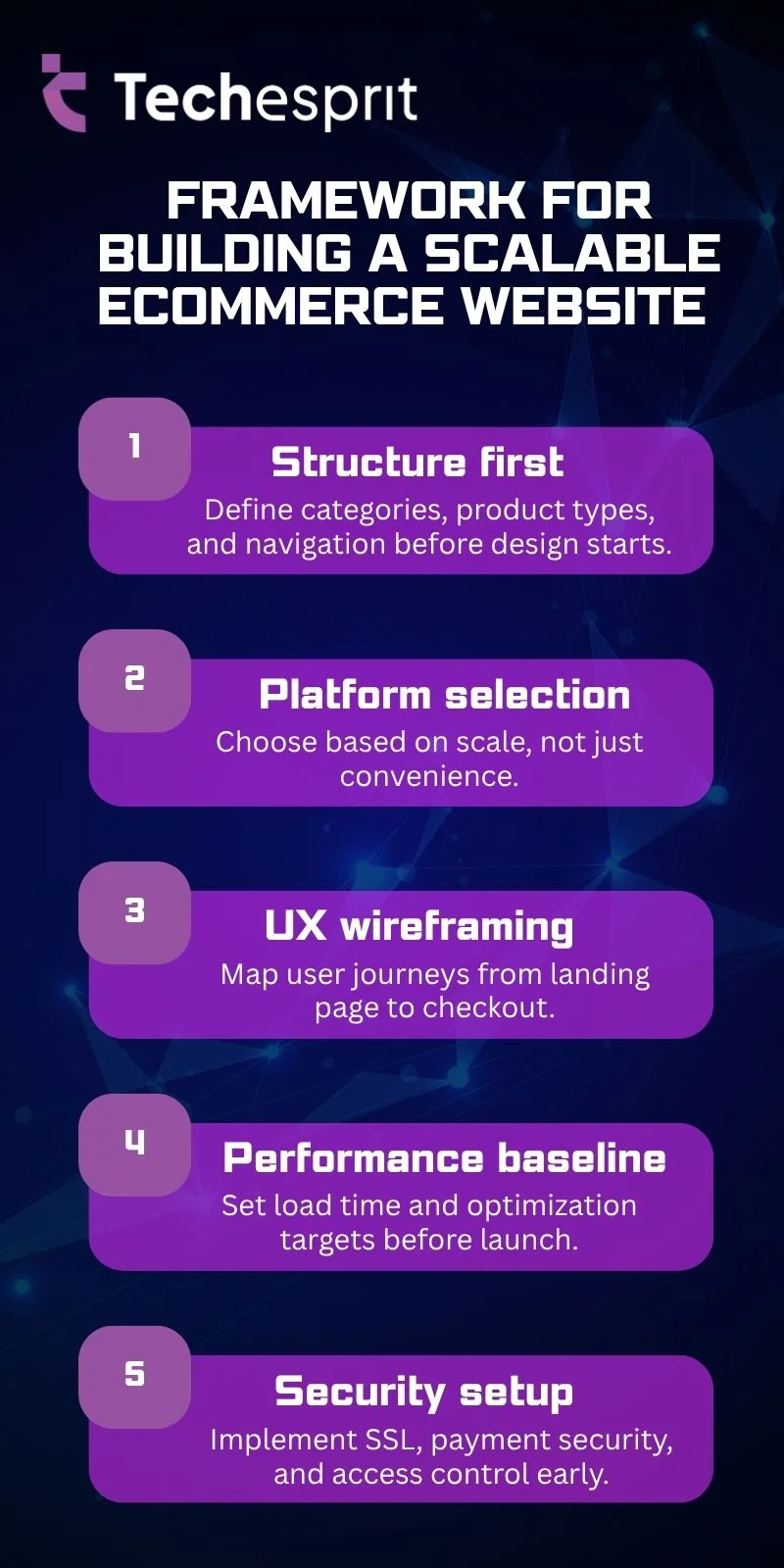
Framework for building a scalable ecommerce website
Common mistakes in ecommerce website development
Many ecommerce projects fail due to avoidable mistakes:
- Overcomplicated homepage layouts
- Ignoring mobile optimization
- Using unoptimized product images
- Weak checkout design
- Poor platform selection early on
The most damaging mistake is treating launch as the final step. In reality, ecommerce development is ongoing optimization.
Conclusion
Ecommerce website development works best when it balances design, performance, optimization, and security from the start. Businesses that focus only on appearance often struggle with conversions, while those that build with structure and scalability tend to grow faster and more consistently.
If there is one takeaway, it is this: ecommerce success comes from continuous optimization, not just initial development. If you are ready to start building or improving your store, contact our team to discuss the right approach for your business.
FAQs
How often should an ecommerce website be updated after launch?
A healthy ecommerce site is reviewed monthly for performance and usability, while major updates like design improvements or feature upgrades typically happen every 6–12 months based on customer behavior data.
Can poor product data affect website performance or sales?
Yes. Incomplete product descriptions, inconsistent images, or missing specifications reduce trust and make users hesitate. It also affects search visibility inside the store, which directly lowers conversions.
How long does it take to develop an ecommerce website?
The timeline depends on complexity. A basic store can take 2–4 weeks, while a custom or large-scale ecommerce platform may take 2–4 months. Delays usually come from content preparation, integrations, and revision cycles rather than coding alone.
What features are essential for a successful ecommerce website?
At a minimum, you need secure payment integration, mobile responsiveness, fast loading pages, product filtering, search functionality, and a smooth checkout process. Without these, even good products can struggle to convert.
How do I know if my ecommerce website needs optimization?
Signs include slow loading speed, high bounce rates, low conversion rates, or users dropping off before checkout. Analytics tools help identify where improvements are needed.
Is SEO important for ecommerce websites?
Yes. SEO helps your products appear in search results, bringing organic traffic without paid ads. Proper structure, keywords, and optimized product pages significantly improve visibility over time.